
 | Starting Point | DNA Part 2 |  |
DNA Part 1
Posted on: 01 April 2024 by Andrew Perry
Posted in: [Creation]
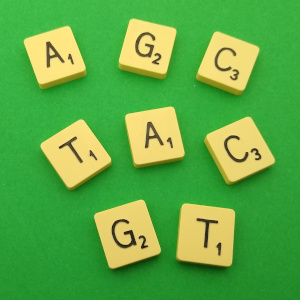
(An advanced message coding system with a 4-letter alphabet)
Nowadays DNA is a well known concept, especially with the extensive use of DNA testing in many areas such as forensic science. We all know as well that we possess things called genes, these being the biological entities that make each one of us who we are and are used to pass on characteristics from parent to offspring. For some, this may be as far as the knowledge of such things goes, so now for a bit more detail.
DNA (deoxyribonucleic acid) is a chemical substance and this is what our genes are made from. Every single cell in our body (with the exception of a few cell types like blood cells) contains a full copy of our genetic blueprint, encoded using DNA.
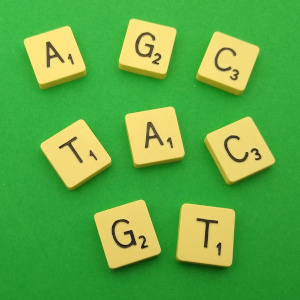
Those of us whose language uses a Latin script will be used to an alphabet based on 26 letters (not to mention any variants using accents, embellishments or special letter combinations). A computer uses a much more basic system – at the lowest level, information in a computer is represented by a combination of just two symbols, namely binary zeros and ones. DNA effectively uses a 4-letter alphabet to write genetic code. DNA is a giant molecule in which many individual building block units (known as nucleotides) are linked together to form a molecular chain. These units come in four varieties called adenine, cytosine, guanine and thymine (abbreviated A, C, G and T) and the order in which these are put together defines the associated genetic code.
It is estimated that it takes approximately 3.2 billion individual nucleotides to define the full human genetic code. That is equivalent to a substantial collection of books. The number of possible sequences that can be made from 3.2 billion letters using a 4-letter alphabet is in the order of 10 to the power of 1.9 billion (in simple terms a ‘1’ followed by 1900 million zeros). That is an unimaginably large number to say the least, enough to blow even the greatest of minds.
This surely begs the question – Is it really feasible that something as large and complex as our genetic code could have possibly written itself through a series of random events, even given millions of years?
| Starting Point | DNA Part 2 | |